
Badminton is easy to start playing, but understanding its rules makes every match more enjoyable. Whether you play singles, doubles or mixed doubles, you need to know how scoring works, where to serve and which shots count as faults.
The Badminton World Federation (BWF) sets the official rules for international competitions. These rules cover everything from court boundaries and serving positions to scoring and player conduct.
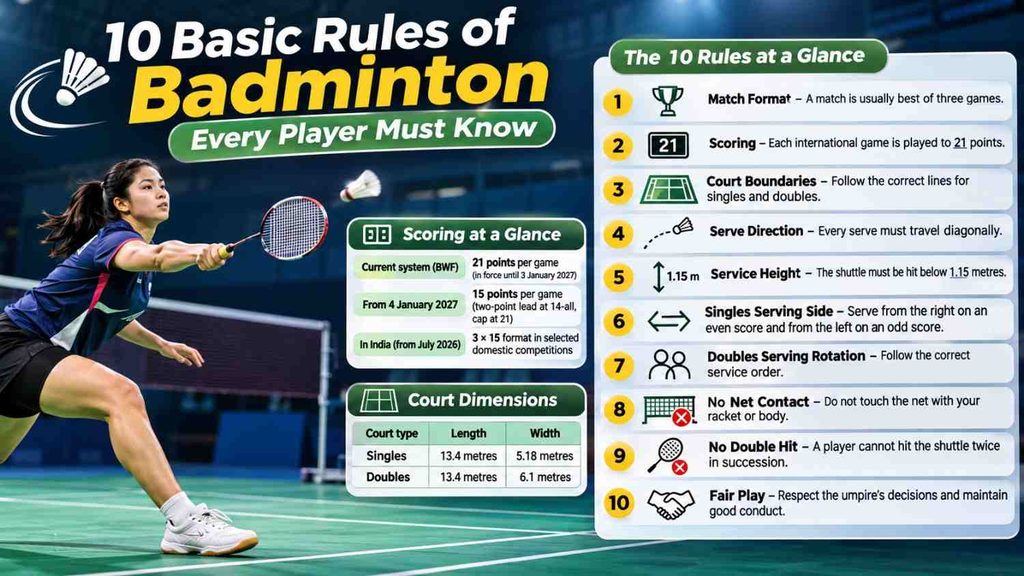
This guide explains the 10 rules of badminton every beginner and regular player should understand. It also covers the scoring changes introduced in selected Indian domestic competitions and the upcoming international rule changes scheduled for 2027.
10 Rules of Badminton Every Player Should Know
1. A Match Is Usually Best of Three Games
A standard badminton match consists of up to three games. The player or pair that wins two games wins the match.
For example, a player who wins the first two games finishes the match without needing a third. If both sides win one game each, they play a deciding third game.
Before the match starts, a toss takes place. The side that wins the toss can choose to serve first, receive first or select which end of the court to start from. The other side makes the remaining choice.
2. Each International Game Is Played to 21 Points
Under the standard BWF scoring system in force for international play on 6 November 2026, each game is played to 21 points.
Badminton uses rally point scoring. This means a point is awarded after every rally, regardless of which side served.
A player or pair normally needs 21 points to win a game. However, there are two important conditions:
- At 20-all, a side must gain a two-point lead to win.
- If the score reaches 29-all, the side that scores the 30th point wins.
For example, a game can finish at 21-18 or 22-20. The maximum score under this system is 30-29.
Important scoring update for 2027: The BWF has approved a new best-of-three-games format in which each game is played to 15 points. At 14-all, a side must gain a two-point lead to win. However, if the score reaches 20-all, the side that scores the 21st point wins. The new international format is scheduled to take effect on 4 January 2027.
In India, the Badminton Association of India (BAI) introduced the 3×15 scoring format in selected domestic competitions from July 2026. Its expanded implementation includes:
- Zonal championships.
- Under-13, Under-15, Under-17 and Under-19 ranking tournaments.
- Senior and masters ranking tournaments.
- Under-11, Under-13, Under-15, Under-17 and Under-19 National Championships.
- Senior National Championships.
- Masters National Championships.
Therefore, the scoring format used in India depends on the competition. International BWF events continue to use the 21-point system until the new international format takes effect.
3. Players Must Follow the Correct Court Boundaries
Badminton uses different boundary lines for singles and doubles. Knowing which lines apply can help players avoid losing points unnecessarily.
The official court dimensions are:
| Court type | Length | Width |
| Singles | 13.4 metres | 5.18 metres |
| Doubles | 13.4 metres | 6.1 metres |
In singles, players use the inner side lines. In doubles, they use the outer side lines.
The back boundary line is used during rallies in both formats. However, the service boundaries are different. Doubles serves must land before the doubles long service line, which is inside the back boundary. Singles serves can reach the back boundary line.
Remember that a shuttle landing on an active boundary line is considered in. The lines form part of the area they mark.
4. Every Serve Must Travel Diagonally
A badminton serve must travel diagonally into the opponent’s service court. The server and receiver must stand in diagonally opposite service courts when the serve is delivered.
The shuttle must cross the net and land inside the correct service area. If it lands outside the service boundaries, the serving side commits a fault and loses the rally.
Players must follow these service conditions:
- The server must not serve before the receiver is ready.
- Both the server and receiver must remain inside their respective service courts.
- Neither player may touch the boundary lines of their service court during the serve.
- Some part of both feet must remain in contact with the court surface in a stationary position until the serve is delivered.
Following these conditions helps players deliver a legal serve and avoid unnecessary faults.
5. The Shuttle Must Be Hit Below 1.15 Metres During a Serve
The official BWF service rule sets a maximum height for contact with the shuttle.
At the moment the racket hits the shuttle during a serve, the whole shuttle must be below 1.15 metres from the court surface.
The racket must initially make contact with the base of the shuttle. Its movement must continue forwards once the service action begins.
Players should also avoid delaying the serve after they and their opponents are ready. An incorrect service can result in a fault and a point for the opposing side.
6. Singles Players Must Serve From the Correct Side
The serving position in singles depends on the server’s score.
The rule is straightforward:
- When the server has an even score, they serve from the right service court.
- When the server has an odd score, they serve from the left service court.
For example, at 0-0, the first serve comes from the right side. If the server wins the rally and moves to 1 point, the next serve comes from the left.
If the receiver wins the rally, they earn a point and become the new server. They then serve from the side that matches their score.
7. Doubles Players Must Follow the Correct Serving Rotation
Doubles has two players on each side, so the serving order can seem confusing to beginners.
The serving side uses its own score to decide where the server stands:
- An even score means the server serves from the right service court.
- An odd score means the server serves from the left service court.
The player standing diagonally opposite the server must receive the serve. The receiver’s partner cannot hit the serve before the receiver returns it.
If the serving pair wins the rally, it earns a point and the same player serves again from the opposite service court.
If the receiving pair wins the rally, it earns a point and takes over the serve. The correct player serves from the service court that matches the new serving side’s score.
Players must not serve or receive out of turn. Partners should understand their positions and rotation before the match begins.
8. A Side Cannot Hit the Shuttle Twice in Succession
During a rally, players must return the shuttle over the net to the opponent’s court.
In singles, the player can hit the shuttle from any position on their side. In doubles, either partner can return it after the serve has been received.
However, a side cannot hit the shuttle twice in succession. The same player cannot make two separate consecutive hits, and doubles partners cannot hit it one after the other before sending it across the net.
Once the shuttle has been returned, the opposing side must also avoid consecutive hits by the same player or by both partners.
The shuttle must travel towards the opponent’s court after contact. If it touches a racket but does not travel towards the other side, the player commits a fault.
9. Touching the Net or Hitting the Shuttle Out Is a Fault
A fault ends the rally and gives the opposing side a point. Players should understand the common situations that lead to faults.
| Fault | What happens |
| Shuttle lands outside the court | The opponent wins the point |
| Shuttle fails to cross the net | The opponent wins the point |
| Player touches the net or its supports during play | The opponent wins the point |
| Shuttle touches a player’s body or clothing | The opponent wins the point |
| Player hits the shuttle twice | The opponent wins the point |
| Doubles partners hit the shuttle successively | The opponent wins the point |
| Receiver’s partner hits the serve before the receiver | The opponent wins the point |
| Shuttle touches the ceiling or a side wall during indoor play | The opponent wins the point |
| Player obstructs or deliberately distracts an opponent | The opponent wins the point |
| Incorrect service | The opponent wins the point |
Players must not touch the net or its supports with their racket, body or clothing while the shuttle is in play.
They must also avoid reaching over the net to hit the shuttle before it crosses to their side. A player may follow through over the net with the racket after making the initial contact on their own side.
10. A Let Means the Rally Must Be Replayed
A let is different from a fault. When an umpire calls a let, the rally is stopped and replayed. Neither side receives a point for that rally.
A let may occur in situations such as:
- The server delivers the shuttle before the receiver is ready, provided the receiver has not attempted to return it.
- The shuttle disintegrates during a rally and its base completely separates from the rest of the shuttle.
- After a return, the shuttle becomes caught on top of the net or gets caught in the net after passing over it.
- Both sides commit a fault during the service.
- An unforeseen or accidental situation interrupts play.
- A line judge cannot see where the shuttle landed and the umpire cannot make a decision.
After a let, the player who served last serves again. The score remains unchanged, and the rally is replayed.
Players should understand this rule because not every interruption means that someone has committed a fault.
Badminton Rules at a Glance
| Rule | Key point |
| Match format | Best of three games |
| International scoring (November 2026) | 21 points per game |
| International winning margin | Two points at 20-all |
| International maximum score | 30-29 |
| New international scoring | 15 points per game from 4 January 2027 |
| Indian domestic scoring | 3×15 in BAI-designated competitions from July 2026 |
| Singles court width | 5.18 metres |
| Doubles court width | 6.1 metres |
| Service direction | Diagonally across the court |
| Service height | Below 1.15 metres |
| Even score | Serve from the right |
| Odd score | Serve from the left |
| Let | Replay the rally |
What Is the Difference Between Singles and Doubles Rules?
Source Image: Olympics
The main difference is the number of players and the court boundaries. Singles has one player on each side, while doubles has two.
Both formats use the same basic rules for faults, lets and legal serves. However, their court markings and service positions differ.
| Feature | Singles | Doubles |
| Players | 2 | 4 |
| Court width | 5.18 metres | 6.1 metres |
| Side boundary | Inner side line | Outer side line |
| Service position | Based on server’s score | Based on serving side’s score |
| Serving direction | Diagonal | Diagonal |
| Rally scoring | Yes | Yes |
Mixed doubles follows the doubles court and service rules. Each team consists of one male and one female player.
Upcoming Badminton Rule Changes in 2027
The BWF has approved changes that will affect international badminton from 4 January 2027.
The main change is the introduction of the 3×15 scoring format. Each game will be played to 15 points, with a two-point lead required at 14-all. If the score reaches 20-all, the next point wins the game.
The existing requirement that the server releases the shuttle without adding spin, introduced as an experimental variation in 2023 after the emergence of the “spin serve”, is also expected to be carried into the revised Laws.
These changes are upcoming rules as of 6 November 2026. Players should continue to follow the existing BWF rules in international competitions until the new rules take effect.
Conclusion
Learning the 10 basic rules of badminton helps players understand scoring, serving, court boundaries and common faults. The most important points are to serve diagonally, use the correct service court, respect the boundary lines and avoid touching the net during play.
Players in India should also check the scoring format used in their competitions. While international BWF matches continue to use the 21-point system in November 2026, BAI has introduced the 3×15 format in designated domestic events from July 2026.
The international scoring system is scheduled to change to 15 points per game on 4 January 2027. Knowing these rules makes it easier to enjoy casual games and compete with confidence.
FAQs About Badminton Rules
The 10 basic rules cover match format, scoring, court boundaries, diagonal serving, service height, singles serving positions, doubles rotation, legal returns, faults and lets.
Under the standard BWF format in force internationally in November 2026, a player or pair needs 21 points and must lead by two points after the score reaches 20-all. At 29-all, the next point wins the game.
No. Touching the net or its supports with your racket, body or clothing while the shuttle is in play is a fault. The opposing side wins the rally.
The shuttle is considered in if it touches an active boundary line. The lines form part of the court area they define. Players must use the correct singles or doubles boundaries when deciding whether a shot is in or out.
The BWF has approved a best-of-three-games format with 15 points per game. A two-point lead is required at 14-all. If the score reaches 20-all, the next point wins, making 21-20 the maximum score. The new international format is scheduled to take effect on 4 January 2027.