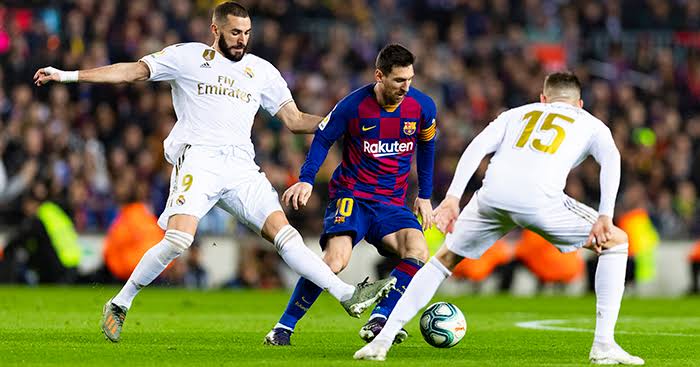
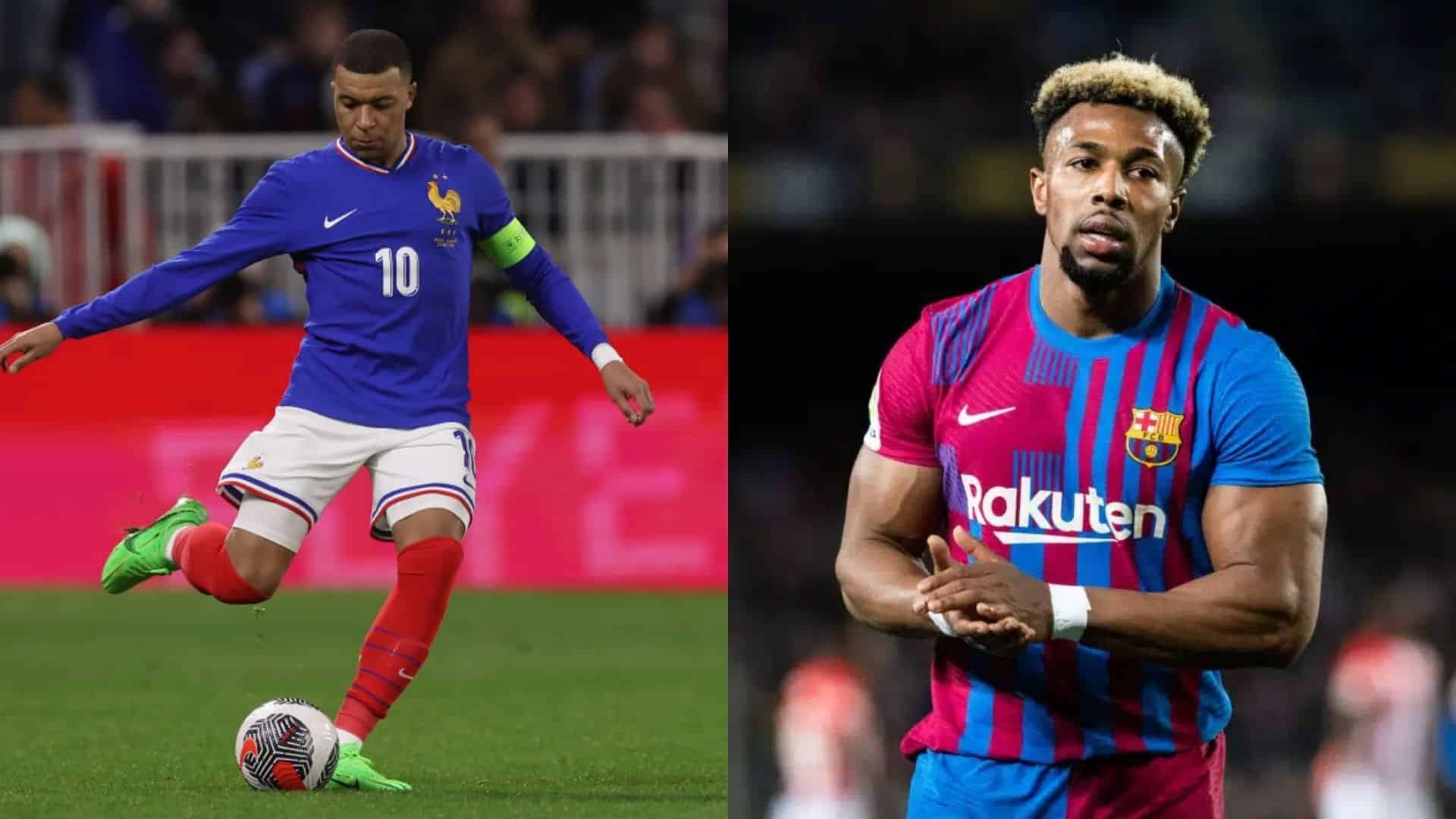
Speed can change a football match in seconds. A winger can leave a defender behind, a striker can turn a through ball into a scoring chance, and a full-back can recover from a dangerous counterattack with one powerful sprint.
But who is actually the fastest football player in the world right now? The answer depends on the competition and tracking system used. There is no single global database that measures every professional player under identical conditions.
Kylian Mbappé, Micky van de Ven, Kyle Walker, Jackson Tchatchoua and Jean-Mattéo Bahoya are among the players with impressive recorded speeds. Some have produced their best numbers in international tournaments, while others have set records in domestic leagues.
This article compares published match-speed figures from recognised competition sources. It also includes current 2026/27 league statistics and explains why a recorded top speed does not always tell the full story about a player’s pace.
10 Football Players with the Fastest Published Match Speeds
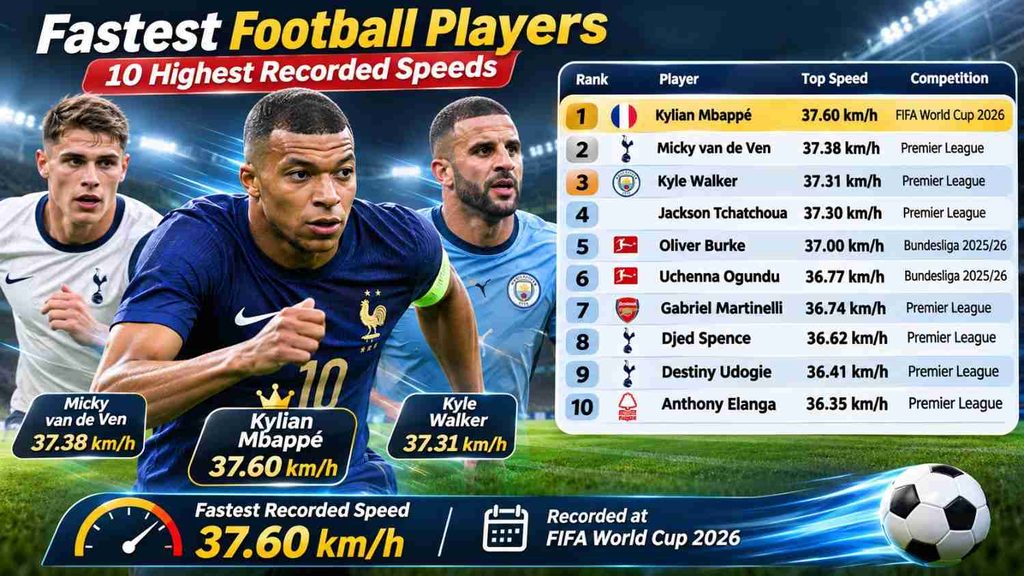
The following table compares notable published match-speed figures from FIFA, Premier League and Bundesliga competitions. The figures were recorded in different seasons and tracking systems, so they should not be treated as an official worldwide ranking.
| Rank | Player | Recorded top speed | Competition |
| 1 | Kylian Mbappé | 37.60 km/h | FIFA World Cup 2026 |
| 2 | Micky van de Ven | 37.38 km/h | Premier League |
| 3 | Kyle Walker | 37.31 km/h | Premier League |
| 4 | Jackson Tchatchoua | 37.30 km/h | Premier League |
| =5 | Jean-Mattéo Bahoya | 37.16 km/h | Bundesliga 2024/25 |
| =5 | Anthony Elanga | 37.16 km/h | FIFA World Cup 2026 |
| 7 | Oliver Burke | 37.00 km/h | Bundesliga 2025/26 |
| 8 | Loïs Openda | 36.84 km/h | Bundesliga 2024/25 |
| 9 | Sirlord Conteh | 36.82 km/h | Bundesliga 2024/25 |
| 10 | Uchenna Ogundu | 36.77 km/h | Bundesliga 2025/26 |
Note: These are published match-speed figures from different competitions and seasons. They are arranged by the reported numbers, but the different tracking systems mean this is not a definitive global ranking.
Current Football Speed Leaders in the 2026/27 Season
Historical speed records should be considered separately from current-season statistics. The following figures provide a snapshot of the fastest players listed in the Premier League and Bundesliga during the 2026/27 season, based on the leagues’ published updates covering matches into late October 2026.
Premier League – 2026/27
| Rank | Player | Top speed |
| 1 | Harvey Barnes | 36.21 km/h |
| 2 | Bradley Barcola | 35.93 km/h |
| 3 | Antoine Semenyo | 35.74 km/h |
| 4 | Thierno Barry | 35.50 km/h |
| 5 | Oscar Bobb | 35.46 km/h |
Harvey Barnes leads the published Premier League speed figures with 36.21 km/h. Bradley Barcola follows at 35.93 km/h, while Antoine Semenyo is third with 35.74 km/h.
These figures reflect the league’s published update and should not be treated as a complete live ranking of every player’s speed in every match.
Bundesliga – 2026/27
| Rank | Player | Top speed |
| 1 | Alphonso Davies | 36.70 km/h |
| 2 | Sheraldo Becker | 36.58 km/h |
| 3 | Joane Gadou | 36.55 km/h |
| 4 | Adam Daghim | 36.14 km/h |
| 5 | Tidiam Gomis | 35.75 km/h |
Alphonso Davies leads the Bundesliga’s published 2026/27 speed statistics with 36.70 km/h. Sheraldo Becker and Joane Gadou follow with 36.58 km/h and 36.55 km/h respectively.
These league tables show current-season performances. They should not be directly combined with historical records from other competitions to create a worldwide ranking.
1. Kylian Mbappé – 37.60 km/h
Kylian Mbappé is one of the most explosive attackers in modern football. His acceleration, balance and ability to carry the ball at high speed make him difficult to defend against.
The French forward recorded a top speed of 37.60 km/h at the 2026 FIFA World Cup, making him the fastest player recorded at that tournament according to FIFA.
Mbappé’s speed is especially dangerous when he receives the ball in open space. He can accelerate past defenders, attack the space behind the defensive line and create scoring opportunities without needing several touches.
His combination of pace, dribbling and finishing makes him much more than a fast runner.
2. Micky van de Ven – 37.38 km/h
Micky van de Ven is one of the fastest defenders in professional football. The Tottenham Hotspur centre-back recorded 37.38 km/h against Brentford on 31 January 2024.
The Premier League confirmed that this was its fastest recorded speed since tracking data collection began in the 2020/21 season.
His pace is particularly valuable when Tottenham defend with a high defensive line. If an opponent gets behind the defence, Van de Ven can use his acceleration to recover and challenge the attacker.
His record also shows that exceptional speed is not limited to forwards and wingers. Modern defenders need pace to handle quick counterattacks and dangerous runs.
3. Kyle Walker – 37.31 km/h
Kyle Walker has been one of the quickest defenders in English football for many years. The former Manchester City right-back reached 37.31 km/h against Everton on 14 May 2023.
His speed helped him defend against some of the world’s best attackers. Walker was particularly effective when dealing with players who relied on pace and direct runs.
His acceleration and recovery speed made him a valuable defender in one-on-one situations. He could also support attacking moves by making powerful runs down the right side.
Walker remains one of the fastest players recorded in Premier League tracking history.
4. Jackson Tchatchoua – 37.30 km/h
Jackson Tchatchoua produced one of the fastest Premier League sprints of the 2025/26 season. The Wolverhampton Wanderers wing-back reached 37.30 km/h against Everton on 30 August 2025.
The Premier League reported that this was the third-fastest speed recorded in its history at that point.
Tchatchoua also reached 36.97 km/h against Crystal Palace on 22 February 2026. His repeated high-speed performances show that his pace is not limited to one isolated sprint.
As a wing-back, he uses his speed to support attacks and recover defensively. This makes him valuable in matches that require repeated movement along the touchline.
5. Jean-Mattéo Bahoya – 37.16 km/h
Jean-Mattéo Bahoya holds the Bundesliga’s all-time top-speed record with a remarkable 37.16 km/h.
The Eintracht Frankfurt winger recorded this speed during an away match against Bochum on 16 March 2025. His sprint made him the first player in Bundesliga tracking history to exceed 37 km/h.
Bahoya’s record-breaking run demonstrated his acceleration and ability to cover ground at exceptional speed. It also placed him ahead of previous Bundesliga speed record holders.
His 37.16 km/h performance makes him one of the fastest footballers in the published competition records.
5. Anthony Elanga – 37.16 km/h
Anthony Elanga recorded a top speed of 37.16 km/h at the 2026 FIFA World Cup, placing him alongside Jean-Mattéo Bahoya in this comparison.
The Swedish forward is known for his direct running, acceleration and ability to attack open spaces. His pace can stretch defensive lines and create opportunities during quick transitions.
Elanga’s World Cup figure is higher than his separately recorded Premier League speed of 36.35 km/h against Chelsea on 20 December 2025. These figures come from different competitions and should be considered separately.
7. Oliver Burke – 37.00 km/h
Oliver Burke was the fastest player in the Bundesliga during the 2025/26 season, reaching a top speed of 37.00 km/h against St. Pauli on Matchday 28, 5 April 2026.
This performance placed him second on the Bundesliga’s all-time speed list, behind Jean-Mattéo Bahoya’s 37.16 km/h record.
Burke’s pace allows him to attack space quickly and challenge defenders in open areas. His speed is particularly useful during counterattacks, when a quick run can turn a defensive recovery into an attacking opportunity.
His 37.00 km/h figure confirms his position among the quickest players recorded in Bundesliga history.
8. Loïs Openda – 36.84 km/h
Loïs Openda recorded a top speed of 36.84 km/h during the 2024/25 Bundesliga season while playing for RB Leipzig.
The Belgian forward is known for his acceleration and ability to exploit spaces behind opposing defenders. His pace makes him particularly dangerous during counterattacks and quick attacking transitions.
Openda’s recorded speed placed him among the fastest players in the Bundesliga that season and ahead of several other established speed specialists.
9. Sirlord Conteh – 36.82 km/h
Sirlord Conteh reached 36.82 km/h during the 2024/25 Bundesliga season while playing for St. Pauli.
His recorded speed placed him among the fastest players in the competition that season. Conteh’s pace allows him to make direct forward runs and challenge defenders when space opens up.
His performance is another example of the exceptional sprint speeds recorded in the Bundesliga.
10. Uchenna Ogundu – 36.77 km/h
Uchenna Ogundu reached 36.77 km/h in the Bundesliga’s 2025/26 top-speed statistics while playing for FC Augsburg.
His inclusion shows how speed is becoming an important quality across different positions and age groups. Young attacking players can use acceleration to create separation from defenders and reach through balls before their opponents.
Ogundu’s recorded speed placed him among the quickest players listed by the Bundesliga for that season.
Other Notable Premier League Speed Figures
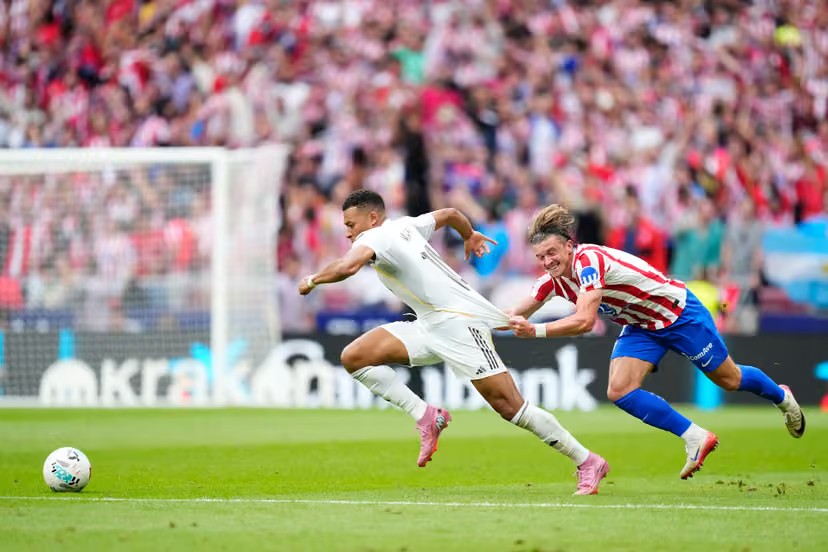
Source Image:sportsboom
Several other Premier League players have also produced impressive sprint figures. Their recorded speeds are below the top 10 in the comparison above, but they remain notable examples of pace in English football.
Gabriel Martinelli – 36.74 km/h
Gabriel Martinelli is known for his direct attacking style and ability to run at defenders. The Arsenal winger reached 36.74 km/h against Newcastle United on 25 April 2026.
Martinelli’s speed helps him attack the space behind full-backs. He can also use quick changes of direction to create room for a shot or cross.
His pace is one reason he remains a dangerous option in wide attacking positions.
Djed Spence – 36.62 km/h
Djed Spence recorded a top speed of 36.62 km/h against Wolverhampton Wanderers on 25 April 2025, according to the Premier League’s published tracking figures.
The full-back combines pace with the ability to carry the ball forward. His speed helps him recover defensively and make overlapping runs when his team attacks.
Fast full-backs are particularly useful in modern football because they must cover large areas of the pitch throughout a match.
Destiny Udogie – 36.42 km/h
Destiny Udogie is another quick defender who can contribute at both ends of the pitch. The Tottenham player reached 36.42 km/h against Brighton and Hove Albion on 20 September 2025.
His acceleration helps him move forward from defence and recover when possession changes. Udogie’s speed is valuable in wide areas, where defenders often need to match the movement of quick wingers.
Anthony Elanga – 36.35 km/h in the Premier League
Anthony Elanga also recorded 36.35 km/h against Chelsea on 20 December 2025 during the Premier League season.
This is a separate competition figure from his 37.16 km/h World Cup speed. His pace makes him an effective option on the wing and during counterattacking situations.
Who Is the Fastest Football Player in the World Right Now?
According to FIFA, Kylian Mbappé recorded the fastest sprint at the 2026 FIFA World Cup, reaching 37.60 km/h. Micky van de Ven holds the Premier League’s recorded top-speed record at 37.38 km/h.
However, there is no single worldwide database that measures every professional player using the same tracking system. These figures therefore do not establish a definitive global ranking of the fastest footballers.
For current league performances in 2026/27, Harvey Barnes leads the published Premier League figures at 36.21 km/h, while Alphonso Davies leads the Bundesliga figures at 36.70 km/h.
Why Is Speed Important in Modern Football?
Speed is one of the most valuable physical qualities in modern football. It helps players create chances, defend against fast attackers and change the direction of a match.
Here are some important reasons why clubs value quick players.
1. Creating Attacking Opportunities
Fast forwards and wingers can run behind defenders and receive through balls in dangerous positions. This forces opposition defenders to stay alert and often creates more space for teammates.
2. Winning One-on-One Battles
A player with strong acceleration can move past a defender before they have time to adjust their position. This is particularly useful for wide attackers who regularly face full-backs.
3. Recovering Defensively
Defenders need speed to recover when opponents launch counterattacks. A quick centre-back can cover space behind the defensive line and prevent an attacker from reaching the goal.
4. Supporting Counterattacks
Teams often use speed to move the ball forward quickly after winning possession. Fast players can turn a defensive situation into an attacking chance within seconds.
5. Maintaining Pressure
Quick players can press opponents, close down passing options and force mistakes. Their movement can make it difficult for the opposition to build attacks comfortably.
How Is a Footballer’s Top Speed Measured?
Professional football competitions use tracking technology to measure player movement during matches. Depending on the competition, this may involve optical tracking cameras, wearable technology or other performance monitoring systems.
The data can measure several aspects of a player’s movement, including:
- Top speed: The highest speed reached during a match.
- Sprint distance: The total distance covered while running above a defined speed threshold.
- Acceleration: How quickly a player increases their speed.
- High-speed running: The distance covered at speeds above a competition’s chosen threshold.
Top speed is usually expressed in kilometres per hour. However, the measurement methods and thresholds can vary between competitions.
This is why a Premier League speed record cannot automatically be compared with a Bundesliga or FIFA tournament figure as if every player had been tested under identical conditions.
Is the Fastest Football Player Always the Best Runner?
No. Top speed is only one part of a footballer’s athletic ability.
A player might reach an impressive speed over a short distance but struggle to maintain it during repeated sprints. Another player might have slightly lower top speed but accelerate faster over the first few metres.
Football also requires balance, stamina, agility and quick decision-making. A winger must control the ball while running, while a defender needs to change direction without losing position.
The best athletes combine speed with technique and tactical awareness.
Conclusion
Football speed records show how important pace has become in the modern game. Kylian Mbappé recorded the fastest sprint at the 2026 FIFA World Cup with 37.60 km/h, while Micky van de Ven holds the Premier League’s recorded speed record at 37.38 km/h.
Jean-Mattéo Bahoya holds the Bundesliga’s all-time speed record at 37.16 km/h. Anthony Elanga also reached 37.16 km/h at the 2026 FIFA World Cup. Other players, including Kyle Walker, Jackson Tchatchoua, Oliver Burke and Loïs Openda, have produced outstanding sprint figures.
The current 2026/27 league statistics add further context, with Harvey Barnes leading the published Premier League figures and Alphonso Davies topping the Bundesliga list.
However, these figures come from different competitions, seasons and tracking systems. They should not be treated as a definitive worldwide ranking. Speed alone does not make a great footballer. The ability to control the ball, make quick decisions and use pace at the right moment is what makes these players so difficult to stop.
FAQs
According to FIFA, Kylian Mbappé recorded the fastest sprint at the 2026 FIFA World Cup, reaching 37.60 km/h. However, there is no single global speed database covering every professional competition, so this does not establish a definitive worldwide ranking.
Micky van de Ven holds the Premier League’s recorded speed record at 37.38 km/h. He achieved this against Brentford on 31 January 2024.
The quickest professional players can reach speeds above 36 km/h. A small number of published match-speed figures have exceeded 37 km/h.
Mbappé recorded 37.60 km/h at the 2026 FIFA World Cup, while Van de Ven reached 37.38 km/h in the Premier League. These are figures from different competition tracking systems, so they do not represent a direct head-to-head speed test.
Wingers, full-backs and centre-backs often benefit greatly from speed. Wingers use it to beat defenders, full-backs need it to cover wide areas, and centre-backs use it to recover when opponents attack quickly.